I have been asked a lot about corn rootworm survival this season primarily about our wet June during traditional hatch times. In 2014, we had a hard cold winter that carried into planting with cool wet conditions during and after planting. June was especially wet with saturated conditions up to just after July 4th.
"So we had an overall lethal crop year for corn rootworm larvae and eggs right?" In most cases that would not be accurate. While we had severe cold with air temperatures in the -20F to -30F range for spells this winter, we still had very adequate snow cover that kept soil temperatures above zero all winter and in most cases it was closer to 10-15F above zero at the coldest. These soil temperatures and the snow cover likely kept most rootworm eggs viable over winter.
"Ok, ok . . the saturated soil conditions in June had to at least kill most of the remaining beetle eggs and larvae right?" That's also not entirely likely as beetle emergence and hatch was delayed a couple of weeks by cool conditions. Remember that corn rootworm egg hatch is closely tied to GDD accumulation during the growing season. They also don't all hatch at once, it is extended over about a months time during the summer. While saturated conditions will potentially kill hatching larvae, it will not kill eggs so if hatch was delayed to after the soil was saturated it likely didn't kill many of them.
"Well that can't be right, I didn't see any beetles scouting fields at silking or just after the completion of pollination." This was very true in 2014, I rarely ran into many beetles during pollination this year. I did however, start seeing them during grain fill and continue to notice more beetles than normal as we move closer to harvest. As we dug roots later in the season this year I have noticed significant feeding in areas of continuous corn, especially on single RW traited corn without insecticide. In one instance we have noticed plant lodging on single traited corn next to straight RR corn treated with Force insecticide. Do we have resistance issues, I don't think so at this time as it is more a result of pressure on COC acres than resistance but will need to be monitored in the future.
One observation over the past two months has been a significantly higher population of Northern Corn Rootworm than I have seen in the past. This is alarming due to the ability of Northern's to exhibit extended diapause meaning they can hatch later or in some instances two growing seasons later. So for 2015 I think that in COC we will have to consider dual modes of action in RW traits or at the very least insecticide on single traits. There is some elevated concern on rotated acres, but I think we are a year out before we see these Northerns cause major problems in rotated fields. With a potential for lower traited corn and reduced insecticide use at lower corn prices I think we will find out just what kind of pressure we have in 2015. I wouldn't count out rootworms being a major pest in 2015, they may surprise us all as they have in the past.
Saturday, October 4, 2014

Saturday, August 23, 2014
What You Need to Know About Roundup Ready 2 Xtend and Enlist
If you haven't heard about Enlist and Roundup Ready 2 Xtend herbicide traits over the past two years you have been hiding under a proverbial agricultural rock. These traits will be here before you know it and will take some understanding and increased management on the part of retailers and farmers.
"Did you say increased management, I thought it was supposed to be easier?" While these technologies will make it easier to bring down weeds post emerge in soybeans, and to a lesser extent in corn, it will take knowledge of the risks associated with these traits and their accompanying herbicides along with what herbicides you can use on them. First you have to understand what each trait contains, and the limitations around them.
The Enlist trait from DOW Agrosciences in soybeans will be tolerant to 2,4D, and not Dicamba. While these herbicides have the same mode of action, plant growth regulators or PGR's, they do not have the same site of action. The Enlist trait in corn will include 2,4D tolerance along with tolerance to "Fop" grass herbicides like Assure II and Fusilade DX. This is nice in that we can use new effective grass control herbicides in Enlist corn, but also frustrating when it comes to volunteer corn control in soybeans. This will take away two very effective, low rate, and cheap volunteer corn herbicides in soybean fields following Enlist corn. The problem here for retailers will be knowing who had Enlist corn the previous year along with what happens when you show up with a Fop in your tank. Likely, we will have to switch to products like Select Max as our only options to control volunteer corn.
The Roundup Ready 2 Xtend soybeans trait will be tolerant to Dicamba, and not 2,4D. This trait is nice in that it will add the ability to do burndowns with Dicamba with no plant back restrictions to
Xtend soybeans. With the better crop safety of our Dicamba based corn herbicides there is no reason to add this trait to corn. There are no grass herbicide traits built into this as well so no worries about volunteer corn herbicides.
You also have to understand what these herbicides do, and the forms we will have to use on these traits. DOW will be coming out with only one form of 2,4D that will be labeled to use on Enlist tolerant crops. Enlist Duo will be the herbicide that DOW releases, and it contains a premix of glyphosate (Roundup) and 2,4D choline, a new form of 2,4D that will be less volatile. Generic 2,4D's that we commonly use on crops will likely not be labeled for use in Enlist crops so using them will be an off label application. In Enlist corn we will be able to use Fop grass herbicides, but they will also have to be labeled for application and will be up to the chemical company to determine if they are going to apply for a new label or supplemental label. Until that happens these applications will also be off label. While 2,4D is a good broad leaf chemical, it will have to be managed for drift, volatility, and potential resistance. There is also very little residual activity with 2,4D.
Monsanto will be coming out with their own premix as well to be used on Roundup Ready 2 Xtend soybeans. This premix will include glyphosate (Roundup) and a lower volatility form of dicamba. One nice thing about Xtend beans is there will be a label on Clarity from BASF to allow it to be applied to these soybeans along with straight Dicamba call Xtendimax from Monsanto. Attention will have to be paid to not using Dicamba formulations meant for corn like Status, Banvel, and Distinct. These products contain a safener meant only for corn so you can't spray corn with these herbicides and not rinse your tank, or hang your boom into soybeans with the Xtend trait. There is slightly better residual to Dicamba, don't expect much more than about 2 weeks of activity. So you still need to consider a pre residual, or a post residual. There will also still be drift, and volatility concerns with Dicamba.
Most retailers are slightly wary of this technology due to confusion between the traits and what can be used on them, along with potential for tank contamination with both 2,4D and Dicamba. There are also concerns with some seed companies using both traits in their lineup leading to even more confusion. Think Roundup Ready launch with the potential for more tank contamination issues. Like any other herbicide trait, we will have to make sure to apply following label recommendations. There are already a couple of weeds with resistance or suspected resistance to 2,4D. Managing drift, and volatility around sensitive crops along with tank proper tank rinse procedures will be things retailers and farmer applicators will have to pay more attention to.
Farmers are cautiously optimistic here where we have little to no resistance issues, I can't imagine how happy those that are in heavy weed resistance are about this trait. These traits are just the first in a line of new herbicide traits coming to soybeans. While these are a step in the right direction, it's important to remember the weed spectrum you are targeting, and respecting labeled rates. There will inherently be some growing pains as we adjust to new traits, but if we can overcome them this should help us all in managing weed resistance.
 |
| PGR injury to soybeans |
The Enlist trait from DOW Agrosciences in soybeans will be tolerant to 2,4D, and not Dicamba. While these herbicides have the same mode of action, plant growth regulators or PGR's, they do not have the same site of action. The Enlist trait in corn will include 2,4D tolerance along with tolerance to "Fop" grass herbicides like Assure II and Fusilade DX. This is nice in that we can use new effective grass control herbicides in Enlist corn, but also frustrating when it comes to volunteer corn control in soybeans. This will take away two very effective, low rate, and cheap volunteer corn herbicides in soybean fields following Enlist corn. The problem here for retailers will be knowing who had Enlist corn the previous year along with what happens when you show up with a Fop in your tank. Likely, we will have to switch to products like Select Max as our only options to control volunteer corn.
The Roundup Ready 2 Xtend soybeans trait will be tolerant to Dicamba, and not 2,4D. This trait is nice in that it will add the ability to do burndowns with Dicamba with no plant back restrictions to
Xtend soybeans. With the better crop safety of our Dicamba based corn herbicides there is no reason to add this trait to corn. There are no grass herbicide traits built into this as well so no worries about volunteer corn herbicides.
You also have to understand what these herbicides do, and the forms we will have to use on these traits. DOW will be coming out with only one form of 2,4D that will be labeled to use on Enlist tolerant crops. Enlist Duo will be the herbicide that DOW releases, and it contains a premix of glyphosate (Roundup) and 2,4D choline, a new form of 2,4D that will be less volatile. Generic 2,4D's that we commonly use on crops will likely not be labeled for use in Enlist crops so using them will be an off label application. In Enlist corn we will be able to use Fop grass herbicides, but they will also have to be labeled for application and will be up to the chemical company to determine if they are going to apply for a new label or supplemental label. Until that happens these applications will also be off label. While 2,4D is a good broad leaf chemical, it will have to be managed for drift, volatility, and potential resistance. There is also very little residual activity with 2,4D.
Monsanto will be coming out with their own premix as well to be used on Roundup Ready 2 Xtend soybeans. This premix will include glyphosate (Roundup) and a lower volatility form of dicamba. One nice thing about Xtend beans is there will be a label on Clarity from BASF to allow it to be applied to these soybeans along with straight Dicamba call Xtendimax from Monsanto. Attention will have to be paid to not using Dicamba formulations meant for corn like Status, Banvel, and Distinct. These products contain a safener meant only for corn so you can't spray corn with these herbicides and not rinse your tank, or hang your boom into soybeans with the Xtend trait. There is slightly better residual to Dicamba, don't expect much more than about 2 weeks of activity. So you still need to consider a pre residual, or a post residual. There will also still be drift, and volatility concerns with Dicamba.
 |
| Dicamba injury to soybeans from improper tank rinse out |
Most retailers are slightly wary of this technology due to confusion between the traits and what can be used on them, along with potential for tank contamination with both 2,4D and Dicamba. There are also concerns with some seed companies using both traits in their lineup leading to even more confusion. Think Roundup Ready launch with the potential for more tank contamination issues. Like any other herbicide trait, we will have to make sure to apply following label recommendations. There are already a couple of weeds with resistance or suspected resistance to 2,4D. Managing drift, and volatility around sensitive crops along with tank proper tank rinse procedures will be things retailers and farmer applicators will have to pay more attention to.
Farmers are cautiously optimistic here where we have little to no resistance issues, I can't imagine how happy those that are in heavy weed resistance are about this trait. These traits are just the first in a line of new herbicide traits coming to soybeans. While these are a step in the right direction, it's important to remember the weed spectrum you are targeting, and respecting labeled rates. There will inherently be some growing pains as we adjust to new traits, but if we can overcome them this should help us all in managing weed resistance.
Tuesday, April 15, 2014
Why Is Weather So Important To Farmers?
 |
| Our weather station at home |
 |
| Part of the office weather station in Mapleton |
Once the crop is growing we also need timely weather as well. During corn pollination we can lose yield if the temperature gets above 90F or the night time temperature doesn't get below 70F since the pollen won't last as long in the heat and if the night doesn't get cool enough the plant can't rest. In 2012, we had farmers lose up to 100 bushels of corn per acre when the temperatures were over 100F during pollination. The same can be said about timely rainfall. In soybeans we need rain in late July and early August to maintain yield along with increase seed size and keep pods from aborting. In this window a 1" rain will typically add around 5 bushels of yield in soybeans or around $55/acre.
 |
| A RadarScope screen shot from 2013 |
There are several more scenarios where we can gain or lose yield based on the weather, but in the grand scheme of things it accounts for up to 70% of our overall yield every year. I don't think there is any other profession out there where an ever changing variable that no one has control over is the main thing you depend on for income. These are the reasons I and our customers pay so much attention to the forecast (and are often upset when it's wrong). So the next time you're mad your lawn is brown, think of that guy who has their whole life invested in something that looks like your lawn and help us pray for rain.
Friday, March 28, 2014
The Importance of Planting Depth
We often hear that you should shallow up your planting to get seed out of the ground faster, or plant deeper to get to moisture. That being said I have also heard that you don't need to worm sheep if you feed them oats, "it spears the worms" as one farmer back home used to say. You tell me which one sounds the worst. While there is some truth to planting deeper in times of extreme drought or when you work too far ahead of the planter, the other two sayings have little merit.
The name of the game really is uniform emergence and putting the seed in a place that will have little variation in temperature and moisture. In the early spring these temperature swings are more likely as we often get those cold wet nights that will effect germination. Later in the season getting seed out of the ground fast is not really an excuse, as soil temperatures warm up I have seen corn come out of the ground in less than 5 days planted 2.5" deep. Corn plants will also set brace roots at the same distance from the crown whether it's 1/2" or deeper so often we will find brace roots set higher on shallow planted corn. This can lead to brace roots burning off in dry soil conditions we often get in July and August.
So what is the ideal seed depth for corn? I'd say 2" is still a very good number, and in worked ground you need to account for 1/4" of settling. I often get the question, so where do I set my planter to get 2"? The best thing we can do is get out and dig. This depth will vary on down pressure, soil type, and planting conditions. This is something I would recommend doing on every field and checking every time you get out to fill the planter. I have seen all sorts of reasons this is a good idea. In the past two years I have seen broken seed disks, missing gauge wheels, and many other things go wrong that were missed for several passes. It's very hard to get a do over on one row across a field.
A seed firmer also helps with even planting depth to get every seed to the exact same depth. A big problem I have seen with some types of row units is that with offset seed disks and RID (Reduced Interior Diameter) wheels is we get seeds hanging up in the side walls from the lower angle of the disks and air pockets left from the bulge in the RID wheels. A firmer will often help with this, but not cure it entirely. These are all reasons I have preferred setups for each area I work in.
So before you head to the field this year, consider planting depth and consistent planting depth while you work on your planter. It's these little things that will determine if each corn plant is a good plant or a weed.
 |
| Plant variation from 1" planting depth |
So what is the ideal seed depth for corn? I'd say 2" is still a very good number, and in worked ground you need to account for 1/4" of settling. I often get the question, so where do I set my planter to get 2"? The best thing we can do is get out and dig. This depth will vary on down pressure, soil type, and planting conditions. This is something I would recommend doing on every field and checking every time you get out to fill the planter. I have seen all sorts of reasons this is a good idea. In the past two years I have seen broken seed disks, missing gauge wheels, and many other things go wrong that were missed for several passes. It's very hard to get a do over on one row across a field.
A seed firmer also helps with even planting depth to get every seed to the exact same depth. A big problem I have seen with some types of row units is that with offset seed disks and RID (Reduced Interior Diameter) wheels is we get seeds hanging up in the side walls from the lower angle of the disks and air pockets left from the bulge in the RID wheels. A firmer will often help with this, but not cure it entirely. These are all reasons I have preferred setups for each area I work in.
So before you head to the field this year, consider planting depth and consistent planting depth while you work on your planter. It's these little things that will determine if each corn plant is a good plant or a weed.
Wednesday, March 12, 2014
Consumers Don't Want To Talk To Me, They Want You
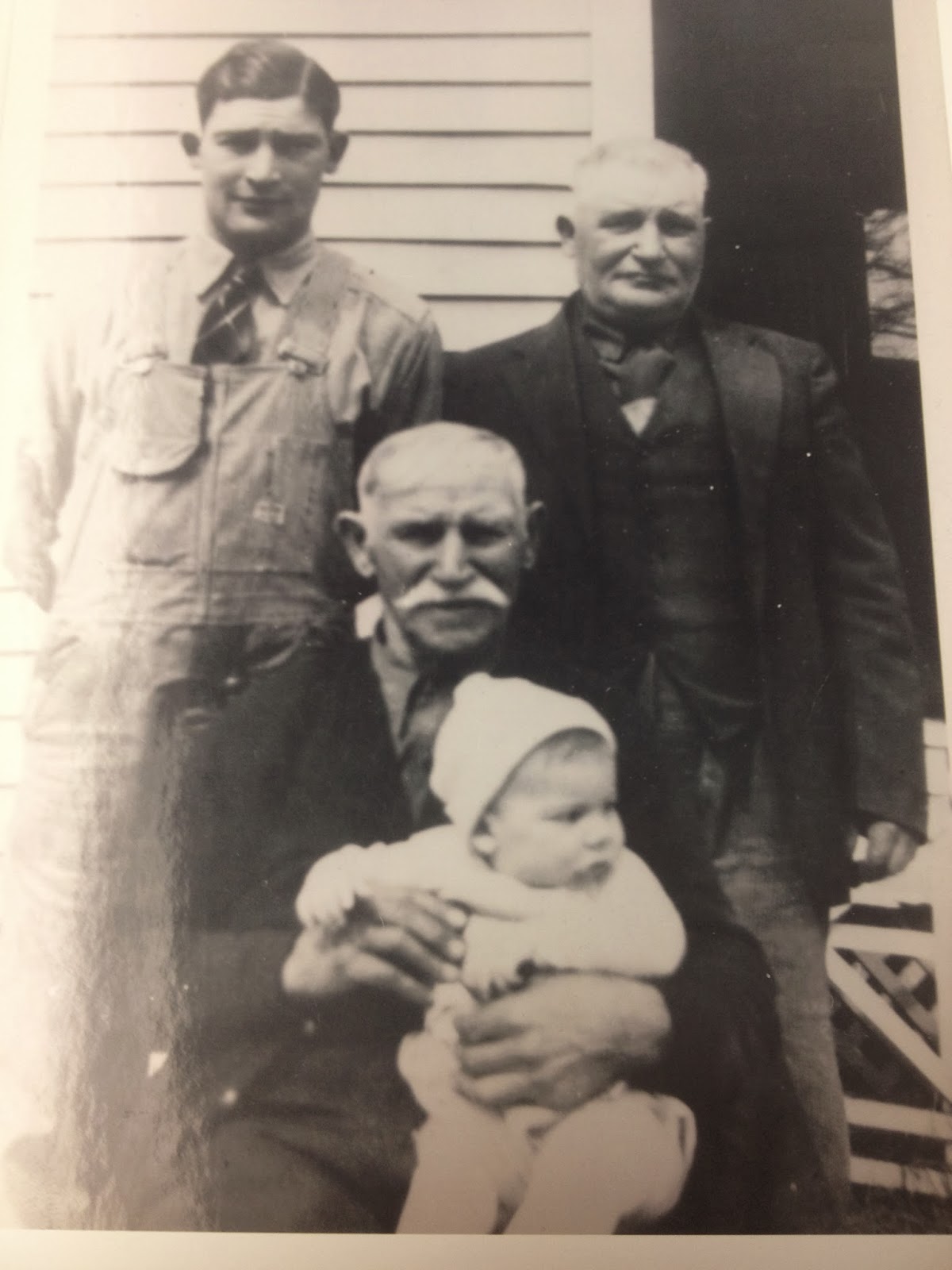 |
| Generations two to five of our family on the same farmstead |
 |
| My wife and I in the tractor cab this fall |
The people they want to hear from is you, the farmers. They trust you more than the government and scientists. In most of their views the government and respected scientists can be bought by the large chemical companies. This is why we are told not to call you producers, you are farmers, that's the
term they recognize and feel comfortable with. In their mind you have a pitch fork in one hand, raise animals like our great grandparents did, and you plow fields with a team of horses. That's what is shown to them from the time they are children.
This takes me back to a few months ago, sitting in that farm office. It shocked my customer so much we had a 30 minute conversation on why I should be the one talking to people not him. "You know the science behind this stuff, and you aren't biased on what company or trait we use," he told me. I know this as well, but they don't want to hear from me. They trust you, and that is why your message is so important. People from country backgrounds are typically reserved about government and the rest of the community. We are hesistant to talk to others about what we do, we mind our own
business, we have done this for years, and if the government passes another law we just work that much harder to follow the rules.
 This is one area where we can't just turn our cheek and say it won't affect us. There has been an increasing scrutiny of what we do regardless of if it's warranted or not. The last 5 years has seen one attack after another on agriculture and it isn't going to get any better. People like the Humane Society of the United States, PETA, and others won't just go away. Unless you tell your story we will see more people blindly back them.
So what can you do? Be kind and courteous to people talking badly about farming. If you can't answer their questions feel free to contact people like me who can get you the answers and break down the science behind the products we use. The most important thing is tell your story. Don't correct them, tell them how you do what you do and why. You can start a blog like several successful ones there already are online. Use social media like twitter and Facebook to connect to young generations.
Two really good examples are:
Dairy Carrie Brian Scott
http://dairycarrie.com/ http://thefarmerslife.com/
I think this is the most important issue facing agriculture right now. It's up to you to defend what you know and love. Farming is a way of life that we love and most don't understand. Your passion and knowledge of what you do is the best way to show people why we are doing the right thing for the security of their food supply.
Thursday, February 27, 2014
Lessons Learned In Vertical Tillage
In the last 3+ years we have seen an increase in use and interest in vertical tillage tools. These tools vary widely in angle of the gangs, disk blade types, and horsepower requirements. In our area we typically see five different models; Landoll VT Plus, Case-IH 330 Turbo, Great Plains Turbo-till, Salford RTS, and the Kuhn-Krause Excelerator. All of these different tools are set up differently and provide different results on residue cover, soil disturbance, and seed bed leveling.
In the fall all of these tools can be used effectively to break up residue and bring up soil to help warm up and dry out the soil in the spring. The straighter angles of the Great Plains and Salford tools will keep the largest amount of residue on the surface and create less soil disturbance. The thing to remember with the straighter angled tools is the horsepower requirement is often higher due to the weight needed to get the tool to penetrate. The angled gangs of the Kuhn-Krause, Landoll, and Case IH will provide the least amount of residue on top leading to an increased chance of erosion, but still less than a traditional chisel plow except the concaved blades on the Landoll VT Plus will be very similar to a chisel plow.
 In the spring we have seen a different effect from using vertical tillage. The straighter angled tools will not provide a seed bed comparable to a finisher or field cultivator. In my opinion, these tools are merely a fall tool that will break up residue for decomposition and fit in a minimum till operation. The higher angled tools will provide a similar seed bed to finishers, but will tend to have more smear while not bringing up wet soil. I have seen two tools in the last two years give unacceptable levels of smear leading to a hard pan just below the depth of planting. This picture shows just what this did to the plants themselves. In most cases I can show you the direction of travel from the differences in height and stalk diameter of the corn plants.
 So is vertical till a replacement for a soil finisher or field cultivator? It really depends on the soil types you are working and spring moisture levels. In our area the straight angled tools are strictly fall tillage and fit very well in minimum till environments that are heavy on corn in the rotation. The more aggressive tools can be used in spring, but need to be kept out of wet soil entirely. If you have noticed in the past 3 years manufacturers are pulling back on the depth of tillage as well with these tools. We have seen the recommendation go from 4" deep in spring and fall to 1.5-2.5" to keep this depth of smear to at planting depth or just above. With all of the scouting and digging I have done I would say that if you buy a vertical tillage tool you should keep your finisher or field cultivator, and watch soil moisture levels in spring. I would also consider using floating row cleaners on your corn planter as more residue is likely to be on the soil surface in spring.
 If you are buying a vertical tillage tool consider HP requirements, angle of the blades, and disk blade types. The Landoll VT has been very popular here, but if you look at it next to a disk you would be hard pressed to tell the difference. At the 2012 Farm Progress Show in Boone, IA John Deere had a very nice demo about the smear layers each tool makes and the soil disturbance. Although, it was slightly counterproductive as it showed that the John Deere tool left a larger smear layer.

As we see more of these tools in the country we are seeing prices come down. I think they have a fit, but be careful how you plan to use them. If you are interested in them I would demo one and do some digging behind the tool in dry soil to see how it affects the soil and if it is fitting the purpose you need.
 As always, I would recommend working with someone who knows the differences by digging behind these tools and has independent knowledge on how they handle your specific growing conditions.
In the fall all of these tools can be used effectively to break up residue and bring up soil to help warm up and dry out the soil in the spring. The straighter angles of the Great Plains and Salford tools will keep the largest amount of residue on the surface and create less soil disturbance. The thing to remember with the straighter angled tools is the horsepower requirement is often higher due to the weight needed to get the tool to penetrate. The angled gangs of the Kuhn-Krause, Landoll, and Case IH will provide the least amount of residue on top leading to an increased chance of erosion, but still less than a traditional chisel plow except the concaved blades on the Landoll VT Plus will be very similar to a chisel plow.
In the spring we have seen a different effect from using vertical tillage. The straighter angled tools will not provide a seed bed comparable to a finisher or field cultivator. In my opinion, these tools are merely a fall tool that will break up residue for decomposition and fit in a minimum till operation. The higher angled tools will provide a similar seed bed to finishers, but will tend to have more smear while not bringing up wet soil. I have seen two tools in the last two years give unacceptable levels of smear leading to a hard pan just below the depth of planting. This picture shows just what this did to the plants themselves. In most cases I can show you the direction of travel from the differences in height and stalk diameter of the corn plants.So is vertical till a replacement for a soil finisher or field cultivator? It really depends on the soil types you are working and spring moisture levels. In our area the straight angled tools are strictly fall tillage and fit very well in minimum till environments that are heavy on corn in the rotation. The more aggressive tools can be used in spring, but need to be kept out of wet soil entirely. If you have noticed in the past 3 years manufacturers are pulling back on the depth of tillage as well with these tools. We have seen the recommendation go from 4" deep in spring and fall to 1.5-2.5" to keep this depth of smear to at planting depth or just above. With all of the scouting and digging I have done I would say that if you buy a vertical tillage tool you should keep your finisher or field cultivator, and watch soil moisture levels in spring. I would also consider using floating row cleaners on your corn planter as more residue is likely to be on the soil surface in spring.If you are buying a vertical tillage tool consider HP requirements, angle of the blades, and disk blade types. The Landoll VT has been very popular here, but if you look at it next to a disk you would be hard pressed to tell the difference. At the 2012 Farm Progress Show in Boone, IA John Deere had a very nice demo about the smear layers each tool makes and the soil disturbance. Although, it was slightly counterproductive as it showed that the John Deere tool left a larger smear layer.As we see more of these tools in the country we are seeing prices come down. I think they have a fit, but be careful how you plan to use them. If you are interested in them I would demo one and do some digging behind the tool in dry soil to see how it affects the soil and if it is fitting the purpose you need.
Subscribe to:
Posts (Atom)