Let's talk about agriculture's least favorite topic, mental health. I recently put out a Rogue Agronomist podcast about my mental health journey talking about my issues I had in high school with suicidal thoughts and dealing with my acne and the medication I took for it that caused me to have these thoughts. I stated in that episode that I'm good now and I've been able to manage my mental health on my own for the past two decades but it took me working on some things I've put off for the past year or so to realize that my mental health wasn't great the past 16-18 months.
This started for me with 2018's harvest, we didn't start out great getting stuck the first day we tried combining and then having the rear axle of our combine break on the attempt to pull it out. In our defense the axle was already cracked and it took pulling on the combine to make it go the rest of the way so we got lucky it didn't happen on the road. The ups and downs of that fall along with other farmers calling with their own mental health issues made me have some issues but I didn't really think too much about them at the time. Then in 2019 prevent plant loomed daily as I ran around trying to find fields to plant, delivered and swapped out seed, and eventually returned a decent portion of my customers seed taking a financial hit to our business that came out of 2020's payments. This was my first year of working on my own and working on a farm. When I took the leap I never imagined I would deal with these issues and I doubt anyone would.
While all of this happened I was doing things I didn't realize I was doing. Normally, I like to work on our house and do projects around the house but in the fall of 2018 I stopped doing all of this. As things stacked up in my professional life I quit following up on projects I wanted to do. I had dead trees in our yard, a roof that leaked, a deck that is collapsing, and some remodeling to do before we could even consider potentially moving closer to my customers and the farm. When I was struggling with work these things made my anxiety worse and I just brushed them off, I got mad when my wife brought them up. I literally would look at my list of to do's and stare at them then do something else, and that's not me at all. It took a toll on my personal life and our home life.
The funny thing is I never noticed, I just put my head down and worked. I would avoid some social things and that affected my work but I realized that and it would upset me but I couldn't figure out why I was doing it. It took until today that I figured out I wasn't right up until now. I've got a roof going on the house Friday, tree guy coming today, I'm working on yard projects and getting a ton of new ideas for our business I am acting on. I started having some success with getting in doors with prospects and finally feeling like I am clicking again, I hit my groove. When I looked at my to do list tonight and saw things getting crossed off it for the first time in over a year it just hit me. I wasn't right, not even at all.
It would be easy to write off the past few months as a result of what was going on in the farming community. It wasn't that, it was me. I wasn't doing what I need to get done at home or in my business because I wasn't right. About three weeks ago I had an inkling that something was going on, to the point I told my wife I wanted to seek some counseling for myself. She asked why and I couldn't muster up anything more than I just want to and I think I needed it. I couldn't really tell her exactly why, I didn't even know, I just felt off. I knew I was having issues getting what I needed accomplished done but I didn't really know why that was, I just couldn't mentally get myself to do it.
With the onset of our national medical crisis I was even more nervous about the future but for some reason something clicked for me in the past couple weeks. We've all had to take a step back and look at what we are doing. Our lives have changed, but many of us are starting to get to the point that all the coverage and attention paid to COVID-19 has started to either be a normalcy or we are so fatigued by hearing about it that we are now moving past it and focusing on what is coming after this is over. I'm not sure what happened, maybe it is the time we are spending together and shutting down our brains from the world to focus on things beyond what is on social media or the news.
I still get questions about what we are planting this year or even if we are going to plant this year (today in fact). Looking back I don't feel well about what happened in my personal and professional life but there's nothing I can do about the past. The thing many people who've never had issues with mental health don't realize is that it can come on without you even realizing, you think you can control this if you just keep your head down and keep working. Asking for help or realizing you have a problem is the last thing you want to do, if I just keep doing what I do like always it'll just work out. There's a stigma associated with saying you have a problem or asking for help, and many are afraid to ask for help to the point that by the time they get there they can't handle it anymore. I saw a quote last year I should have paid more attention to "I'm only responsible for my own happiness not everyone else's". While your hapiness is your responsibility we still rely on others for support and help. Don't ever be afraid to ask for help or talk to those you trust about your issues. I've had this happen to me several times in my career, and each time it's during a busy time of the year but I stop what I'm doing and ignore everything else to just talk. Often just talking through issues can help but in one instance I've had to reach out to another person for help with someone who was having issues. There's always going to be someone willing to help, while others may depend on you it's ok to depend on others as well.
Wednesday, April 1, 2020

Monday, October 22, 2018
Take Time to Fight For Every Inch
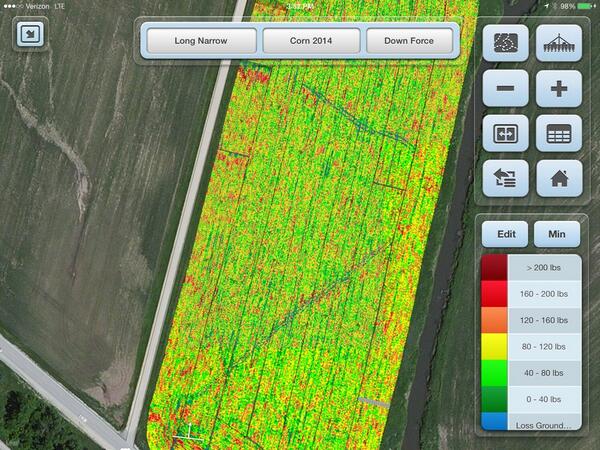
Combining this week has been interesting with weather, equipment, and ground condition issues abound. One thing we did see was one field where down pressure was not working for part of the field when it was planted. Where it was, we saw a 20 bushel bump from better planting depth and spacing. So for 10 acres of a field we lost $600 from not taking time to fix an issue on the planter that took 15 minutes to fix, that works out to about $2,400/hour worth of our time to fix the issue we found.
 I get it, we all get in a rush to put crops in, take care of them, and harvest them all on time but those minor issues we ignore while we are in that rush can cost real money and bushels. It's often that
during harvest we really find out what we lost by not waiting for drier conditions, fixing small issues, or making sure our spacing is correct, etc. It's amazing to see how much just little mundane things will affect the outcome of our crops.
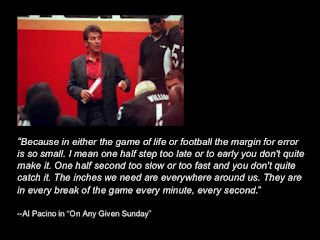
I love the speech from Any Given Sunday where Al Pacino talks about how the little things make a huge difference in the outcome of life and in the game. Agriculture has a lot to do with this quote. In the pursuit of more yield we can forget the little things that lay the ground work for that payday. My focus has always been those little details that we focus on.
While some may recommend products to fix issues, paying attention to details and having a plan going into the season is a far better approach. We spend a large chunk of the winter talking about tillage, planter setup, and soil conditions for a reason. Our goals should always be higher than what we are currently doing, and there are ways to get there. While products can make a difference in how our crop comes out in the end, there is always a cost associated with them. Sometimes making little tweaks, or stopping to fix issues can benefit us by only a minor time investment. That's our focus, taking the time to understand what we are doing that could be changed easily to gain those bushels at minimal cost. So instead of products, spend your time to dial in your agronomy. Those are the inches you can gain that maybe can get you to your goal.
 I get it, we all get in a rush to put crops in, take care of them, and harvest them all on time but those minor issues we ignore while we are in that rush can cost real money and bushels. It's often that
 during harvest we really find out what we lost by not waiting for drier conditions, fixing small issues, or making sure our spacing is correct, etc. It's amazing to see how much just little mundane things will affect the outcome of our crops.
I love the speech from Any Given Sunday where Al Pacino talks about how the little things make a huge difference in the outcome of life and in the game. Agriculture has a lot to do with this quote. In the pursuit of more yield we can forget the little things that lay the ground work for that payday. My focus has always been those little details that we focus on.
While some may recommend products to fix issues, paying attention to details and having a plan going into the season is a far better approach. We spend a large chunk of the winter talking about tillage, planter setup, and soil conditions for a reason. Our goals should always be higher than what we are currently doing, and there are ways to get there. While products can make a difference in how our crop comes out in the end, there is always a cost associated with them. Sometimes making little tweaks, or stopping to fix issues can benefit us by only a minor time investment. That's our focus, taking the time to understand what we are doing that could be changed easily to gain those bushels at minimal cost. So instead of products, spend your time to dial in your agronomy. Those are the inches you can gain that maybe can get you to your goal.
Tuesday, August 21, 2018
How Do You Perceive Value?
I've often been told no matter how long the meetings you attend are you will likely take 2-3 things home from them. When I attended a training a couple weeks ago one story was something I took home and dissected. The presenter talked about a story of buying gloves at a store when they were on sale for 50% off. When he took them to the register the woman behind it said he should have been there last week when they were buy one get one free, it was a "better deal". While most logical people would understand that if you buy one and get the other free essentially buying two at 50% off is exactly the same "deal", this cashier didn't see it that way.
 The question here is really how do you or your customers perceive value. While something may be a deal to one the other may not see it that way. Agriculture is full of these "deals" and often they are the same or if you run the numbers maybe one that doesn't appear to be a deal is in fact a better deal. We are often distracted by price and don't look at the "value" in products we are buying. I was routinely frustrated growing up with a father who valued price over quality. In one instance we were looking at brake pads for my car when I was a teenager and I remember him buying the cheapest ones we could find only to have to replace them a year later, swearing as we did it a second time. I think the cheap organic ones were something like $25 while the better longer lasting ceramic pads were $50. Just think about how much time it took to replace them along with the added trip to the store and the swearing that ensued. In reality, we likely didn't break even on the fact we replaced the pads twice in one year with all the added work. These stories remind me why I often take out a calculator (open the app on my phone), or pull out a pen and paper and do the math on the alternatives. At the time it was frustrating but as I get older these "lessons" taught me to look at all the facts and think with a business mindset about decisions.
In Ag, we see these situations present themselves more often than not. In a previous life I sold potash that had a 62% analysis at a $10 higher price/ton. When you actually did the math at current prices it made financial sense that even at a higher price we were in fact cheaper per unit of K. Believe it or not that was a tough sell a lot of times. Farmers perceived that it was the same product and it was hard to see past a difference in price. We did get an additional margin on selling the higher analysis, but was that worth losing sales over perceived value?
I've also been part of the seed financing debate and a lot of that was perceived value as well. Many companies offer financing at different interest rates, with some having 0% financing and charging more for the seed up front, others advertising 0% financing but in the fine print it's 0% over prime, and others just regular financing at a certain interest rate based on the prime interest rate. Which one would draw most peoples attention? A lot of farms gravitated towards anyone offering 0% financing with the perception they got a deal when they in fact often paid 3-5% more for seed to cover the financing.
So what is the moral of all this? When you are making purchase or business decisions weigh out the actual cost of products over what the perceived costs are. Most people or companies are not trying to pull wool over your eyes with deals, they are merely trying to create programs that are appealing to a broad group. When asked they should explain all the programs or "deals" to you in detail, if they don't want to that's another blog post...
With lower commodity prices and potentially higher input costs it's important to weigh your options and think long term not just about saving a dollar today. Spending time analyzing farm expenses and purchases is something you should regularly be doing. It makes good fiscal sense and will help you in the long term to continue to be a viable business.
 The question here is really how do you or your customers perceive value. While something may be a deal to one the other may not see it that way. Agriculture is full of these "deals" and often they are the same or if you run the numbers maybe one that doesn't appear to be a deal is in fact a better deal. We are often distracted by price and don't look at the "value" in products we are buying. I was routinely frustrated growing up with a father who valued price over quality. In one instance we were looking at brake pads for my car when I was a teenager and I remember him buying the cheapest ones we could find only to have to replace them a year later, swearing as we did it a second time. I think the cheap organic ones were something like $25 while the better longer lasting ceramic pads were $50. Just think about how much time it took to replace them along with the added trip to the store and the swearing that ensued. In reality, we likely didn't break even on the fact we replaced the pads twice in one year with all the added work. These stories remind me why I often take out a calculator (open the app on my phone), or pull out a pen and paper and do the math on the alternatives. At the time it was frustrating but as I get older these "lessons" taught me to look at all the facts and think with a business mindset about decisions.
In Ag, we see these situations present themselves more often than not. In a previous life I sold potash that had a 62% analysis at a $10 higher price/ton. When you actually did the math at current prices it made financial sense that even at a higher price we were in fact cheaper per unit of K. Believe it or not that was a tough sell a lot of times. Farmers perceived that it was the same product and it was hard to see past a difference in price. We did get an additional margin on selling the higher analysis, but was that worth losing sales over perceived value?
I've also been part of the seed financing debate and a lot of that was perceived value as well. Many companies offer financing at different interest rates, with some having 0% financing and charging more for the seed up front, others advertising 0% financing but in the fine print it's 0% over prime, and others just regular financing at a certain interest rate based on the prime interest rate. Which one would draw most peoples attention? A lot of farms gravitated towards anyone offering 0% financing with the perception they got a deal when they in fact often paid 3-5% more for seed to cover the financing.
So what is the moral of all this? When you are making purchase or business decisions weigh out the actual cost of products over what the perceived costs are. Most people or companies are not trying to pull wool over your eyes with deals, they are merely trying to create programs that are appealing to a broad group. When asked they should explain all the programs or "deals" to you in detail, if they don't want to that's another blog post...
With lower commodity prices and potentially higher input costs it's important to weigh your options and think long term not just about saving a dollar today. Spending time analyzing farm expenses and purchases is something you should regularly be doing. It makes good fiscal sense and will help you in the long term to continue to be a viable business.
Tuesday, August 14, 2018
Soybean Aphid Scouting R5 and Beyond
With a flourish of calls today it's that time of year again, when we are nearing the end of the growing season and soybeans are almost past soybean aphid threshold timing. When soybeans reach the R5 growth stage we typically will see a late season flush of aphids and with it a rush of panic from growers worried they need to spray. The interesting thing for me is not the farmer calls I get it's often the other agronomists trying to assuage their growers fears calling me for advice. So here it is, what I look for scouting aphids from R5 on.
The common threshold for spraying soybeans for aphids is a population of 250 aphids/plant at R3-R4 with that changing to 250 aphids/plant and growing during R5 or podfill. R5 is when you have a seed 1/8" long at one of the top four nodes on the soybean plant. A node is classified by having a fully developed leaf which really means any node on the main stem with a fully developed leaf (the leaflets are not touching and fully out). Most soybeans are fully into this stage right now with some reaching R5.5 which is when we have a seed filling half the cavity in the pod on those top four nodes. At R5.5 our threshold for soybean aphids is really up in the air, but the common theme continues 250 aphids/plant with population increasing. The reason for paying attention to R5.5 is that R5 only really lasts about two weeks and thresholds are developed to allow for finding populations and taking 7 days to get there to spray hence being a "spray threshold". So, in theory if we are half way through the stage that lasts two weeks by the time we would spray at the economic threshold of 1,000 aphids/plant (the actual threshold before we see economic loss) by the time we would spray we may be beyond treatment timing.
For many who have not seen economic thresholds of soybean aphids in the past 10 years (the last time I have on a large scale) the field would have to be coated in aphids and honeydew they secrete. These fields you walk out of with stiff pants, stained green and sticky. In all likelihood we will not see this happen in 2018 outside of fields that have hot spots. Another important note of why we have not seen these populations in the past 10 years is the abundance of beneficial insects like lady beetles/larvae, minute pirate bugs, lacewings, and many others. I did some tillage a week ago on prevent plant ground with a grill filled with minute pirate bugs. Lady beetles/larvae will often eat upwards of 100 aphids per day and continue feeding until soybean plant senescence at R7-8 or when they decide your house is more hospitable than a field.
Walking a lot of fields in over seven counties in Wisconsin the past eleven years I have seen many things and had the chance to understand what will happen if we don't spray or we do spray at this late of a stage. The most intersting thing to be a part of is trying to understand what white dwarf soybean aphids mean and do as we get later in the season. The white dwarf stage of aphids is still an often debated stage with questions around what do they mean to the population and what their presence means when it comes to soybean feeding. What we know is that white dwarf soybean aphids live half as long as regular aphids, reproduce less, and cause significantly less damage. The unknowns are really what their presence means to soybean aphid populations. It's thought that their appearance means the aphid population is noticing a reduction in the sugars in the plants. In my experience once we see them the population is in a drastic decline and should be reevaluated in 3-5 days. Often after this period of time we see the population disappear or go down significantly.
So, scouting during R5 is usually an easy decision for me in many fields. If you see soybean aphids at early R5 colonizing the stems on some plants and conditions are favorable for increase by all means get the sprayer out and spray them ASAP. Pay attention to pre harvest intervals on the insecticide of your choosing as that will be happening in 45 days or so. If aphids are at 250 aphids/plant come back in 3-5 days to check to see if they are rising and make the spray determination that day. If you are near or past R5.5 and notice the presence of white dwarf stage aphids check again in a few days but it's very likely you will be past spraying. The only caveat here is if you are under drought stress and seeing soybeans flipping leaves in a majority of the field and are no where near R7, get the sprayer out and spray if you feel that there's a chance of a decent crop in that field and are at or near 250 aphids/plant.
The common threshold for spraying soybeans for aphids is a population of 250 aphids/plant at R3-R4 with that changing to 250 aphids/plant and growing during R5 or podfill. R5 is when you have a seed 1/8" long at one of the top four nodes on the soybean plant. A node is classified by having a fully developed leaf which really means any node on the main stem with a fully developed leaf (the leaflets are not touching and fully out). Most soybeans are fully into this stage right now with some reaching R5.5 which is when we have a seed filling half the cavity in the pod on those top four nodes. At R5.5 our threshold for soybean aphids is really up in the air, but the common theme continues 250 aphids/plant with population increasing. The reason for paying attention to R5.5 is that R5 only really lasts about two weeks and thresholds are developed to allow for finding populations and taking 7 days to get there to spray hence being a "spray threshold". So, in theory if we are half way through the stage that lasts two weeks by the time we would spray at the economic threshold of 1,000 aphids/plant (the actual threshold before we see economic loss) by the time we would spray we may be beyond treatment timing.
 |
| White Dwarf Aphids |
 |
| Several White Dwarf Aphids among two regular soybean aphids |
So, scouting during R5 is usually an easy decision for me in many fields. If you see soybean aphids at early R5 colonizing the stems on some plants and conditions are favorable for increase by all means get the sprayer out and spray them ASAP. Pay attention to pre harvest intervals on the insecticide of your choosing as that will be happening in 45 days or so. If aphids are at 250 aphids/plant come back in 3-5 days to check to see if they are rising and make the spray determination that day. If you are near or past R5.5 and notice the presence of white dwarf stage aphids check again in a few days but it's very likely you will be past spraying. The only caveat here is if you are under drought stress and seeing soybeans flipping leaves in a majority of the field and are no where near R7, get the sprayer out and spray if you feel that there's a chance of a decent crop in that field and are at or near 250 aphids/plant.
Sunday, July 22, 2018
How Important Is Updating Technology?
One of the biggest struggles I run into is advice on updating technology, or really why should you update technology if the current technology is doing what you want. I'll be honest, the cost is usually not cheap by any means to update. Current yield monitors and GPS units can run upwards of $10k and get you very similar data. I often get comments on how new everything I use is, or how "fancy" it is but I think its essential to be running the latest technology in the job I do and on the farm.
I've spent hours trying to get old monitors or technology to do things it was never designed to do in the first place. Installing aftermarket GPS's, making one brand talk to another, and even using a computer to process 4K video even though it wasn't meant to ever handle it. In most cases, an investment of $1-2k would have been easier, but the cheaper option involved several hours of frustrating work. A lot of this work, if it was charged on a per hour basis, would have equaled the cost of the plug and play equipment option and would have had less service calls and issues.
If you just want data for basic analysis or basic functionality by all means go with the cheapest option, but keep in mind what you may be doing 3-5 years down the road. A lot of initial equipment doesn't work with the more advanced programs or hardware, so sometimes saving money up front will require you to purchase better equipment down the road capable of handling more advanced tasks and programs. If make an entry level purchase, look at what the capabilities are if you ever plan to got with more advanced hardware or programs.
For those who are into using data and want better functionality, never go cheap. The problem with most technology is that by the time you get the most advanced thing on the market in less than a year there is usually something better, newer, greater, etc. While often costly at first, there are many programs for trading in for the newest equipment. In many years of working with technology I've learned if you want the best, you're going to pay for it. The key take away however, is that you get the best data, functionality, and it's often more user friendly. If you can make the data pay the investment is almost always worth it. I hate to use the "garbage in, garbage out" analogy, but it definitely applies to data.
My biggest push back is often the price of updating every year or so, but when it comes to using new tech I'm usually the first call to use my own hardware since it is the newest and has features/can do things that what is in our inventory can't do. It's frustrating since those I try to convince to upgrade and often get shot down, are often the one's who want what I can do with the hardware I purchased personally to do what I needed that our old hardware would not do. If you want to be the leader in technology, you're going to pay for it and realize that it's not a one time investment. It takes yearly updating and spending time seeing what is on the market that may be better than what you are currently doing. The best thing I have found is to follow some market leaders and see what they are testing and purchase what they end up buying. It's also helpful to find the companies that are constantly growing and coming out with new products. It's much easier to find a handful of companies who are at the top of hardware and software and getting their new products than buying from several and changing back and forth.
In summary, if you want good data or media bite the bullet and pay the price. In the end it will be easier and you will be the tech leader who produces content/data that others drool over. If you do it correctly, you'll get back what you invest and then some.
Wednesday, January 24, 2018
One Year, One Focus
I've attended a few meetings on the subject of "there's 1,000 variables that affect a crop" and it can be a little overwhelming if you think about what those 1,000 things are. Instead I like to use a one year, once focus approach for those I work with. There are many reasons I do this; fixing every issue in one year is not cost effective, when you have several things to do it's hard to focus on many things, and making whole hog changes can be dangerous if not done in steps.
I recently attended a Winfield event where Director of Insights and Partnerships, Jim Hedges, said that "the things I didn't do were the things (on my farm) that cost me the most." That quote is exactly the thing we need to focus on. Often it's the little things like not applying an insecticide or changing a tillage practice we noticed was hurting us that will haunt us again in the future. His talk was around using technology insights to have better in season decision making so you can take action earlier and with better chances of returns. While the value of in season decisions can pay big returns it's often the little things we overlook.
 Two years ago I noticed that we had a reduced plant stand compared to others with similar programs and we spent the entire summer working on why that was. The root of the cause was somewhere between soil conditions at planting and the amount of in-furrow starter we were using (too much).
We lowered our starter rate, and used a biological fungicide along with our planned in-furrow insecticide with the singular goal of increasing plant stand and uniformity in 2016. That was it, just one goal for the year and it paid big dividends with a two-thousand plant increase that led to a 14 bushel farm average increase over 2015 all the while reducing our cost per bushel.
Singular focuses have paid big dividends in other operations as well. Another farm I work with was having a similar issue with plant stand a few years ago, but it was from residue in the seed trench and issues with closing. We changed closing wheels to a slightly more aggressive closer one year, and saw a significant improvement but not what we wanted. So, the following year we also added trash wheels ahead of the row units behind their zone-till coulters on their planter and finally had a plant stand we were happy with.
It is likely that these are not issues on every operation, but there are many things we can be doing different every year. The key is to find someone willing to work with you to find these little things that you can improve on your operation and making a yearly focus on them to improve crop performance and profitability. While we often focus on agronomy subjects things we can improve are not just limited to agronomy since marketing is often another aspect that we need to improve.
The options here are really limitless (back to the 1,000 variables thing), but they are fixable. For me, I come up with one slogan for the year and write it down on my white board in my office at the top. This year's slogan is what is important for me when we work with our customers and is my singular focus for 2018 "grasp input costs so we can react to markets, and execute our plan". If you find a singular focus for your operation in 2018, own it and make it all you are about for this year.
I recently attended a Winfield event where Director of Insights and Partnerships, Jim Hedges, said that "the things I didn't do were the things (on my farm) that cost me the most." That quote is exactly the thing we need to focus on. Often it's the little things like not applying an insecticide or changing a tillage practice we noticed was hurting us that will haunt us again in the future. His talk was around using technology insights to have better in season decision making so you can take action earlier and with better chances of returns. While the value of in season decisions can pay big returns it's often the little things we overlook.
 Two years ago I noticed that we had a reduced plant stand compared to others with similar programs and we spent the entire summer working on why that was. The root of the cause was somewhere between soil conditions at planting and the amount of in-furrow starter we were using (too much).
We lowered our starter rate, and used a biological fungicide along with our planned in-furrow insecticide with the singular goal of increasing plant stand and uniformity in 2016. That was it, just one goal for the year and it paid big dividends with a two-thousand plant increase that led to a 14 bushel farm average increase over 2015 all the while reducing our cost per bushel.
Singular focuses have paid big dividends in other operations as well. Another farm I work with was having a similar issue with plant stand a few years ago, but it was from residue in the seed trench and issues with closing. We changed closing wheels to a slightly more aggressive closer one year, and saw a significant improvement but not what we wanted. So, the following year we also added trash wheels ahead of the row units behind their zone-till coulters on their planter and finally had a plant stand we were happy with.
It is likely that these are not issues on every operation, but there are many things we can be doing different every year. The key is to find someone willing to work with you to find these little things that you can improve on your operation and making a yearly focus on them to improve crop performance and profitability. While we often focus on agronomy subjects things we can improve are not just limited to agronomy since marketing is often another aspect that we need to improve.
The options here are really limitless (back to the 1,000 variables thing), but they are fixable. For me, I come up with one slogan for the year and write it down on my white board in my office at the top. This year's slogan is what is important for me when we work with our customers and is my singular focus for 2018 "grasp input costs so we can react to markets, and execute our plan". If you find a singular focus for your operation in 2018, own it and make it all you are about for this year.
 |
| What will go on YOUR white board? |
Wednesday, September 30, 2015
Crop Management in Tough Times
As we enter the '16 crop season there seems to be more questions and uncertainty in the country than answers and guidance. Over the past couple seasons I have been working with several growers on preparing for a downturn in crop prices and managing through these times. Below are several of the strategies we have been working on that have worked so far.
Examine Your Low Producing Acres
We do an excellent job managing our good acres, but seem to put low producing acres on the back burner. Our good producing acres make us money, but your lowest production ground loses you money. While a field can still get you a good overall yield, putting the same fertilizer and inputs into low yielding areas as your top areas costs you money. The key for us has been using the tools we have to manage these areas so we don't put money where it's not needed. 3-5 years of good yield data can help you to determine these areas and apply fertilizer accordingly. VRT fertilizer based on crop removal and variable rate nitrogen can reduce the amount of inputs you put on areas that will just not get you the return on investment you need. The biggest thing for us the past few years has been finding these areas and determining what's the reason for their lower production. Sometimes its something simple like compaction, or fertility and in some cases they are just low producing soil that will never come up to meet the average for the field. Fixing problem spots is probably the most rewarding feeling I've had, and everyone knows what its like to have a good average going then watching it go down when you take off these spots in every field.
Spread Your Risk With Land Leases
Over 80% of agricultural land is rented, and most use the same contract to lock these acres up for a few years. If you ever talk to someone who does snowplowing in winter they typically spread their risk by three types of contracts; 1/3 are by the inch, 1/3 are by the snowfall, and 1/3 are by the season. Whether they have a low snowfall season, a season with several small snowfalls, or a few big snowfalls they are covered. A typical lease agreement in agriculture is so much for every acre a year over a certain amount of years. Try doing three different kinds of leases; a certain amount per year, yield based, and market based. Flex rent contracts are a way to hedge your risk on a certain amount of your land. Determining the land owners who will fit each type of contract is key. Just like marketing, it's all about spreading your risk.
Take the Emotion out of Marketing
If you trade stocks or have investments we all know it's about the long haul. I'll be honest, I've hit a few big trades but I've also taken a few bad investments(including one stock that I still own that's lost over 50% of it's value). The biggest thing I have learned working with grain merchandisers and investment "experts" is that you have to take the emotion out of any market. Markets don't have to do anything, and often will do what we don't expect. I work with growers on establishing their breakeven per acre and per bushel to determine when we should be marketing grain. Some years we don't get the highest price, but we try to focus on average prices above our costs IE. ROI. The biggest breakthrough we had was a few years ago when we started marketing grain every time we got any kind of selling signal. Even if you think the market may go up you should sell some amount of grain if you are thinking about it, we've hit more of the up days in a rally this way. If you work with a merchandiser capable of doing puts and calls take advantage of them, again hedge your risk. Leave the coffee shop talk to someone else, worry about making the most per acre over the long run not who sold one contract for the most.
Evaluate Equipment Costs
A couple years ago I had a grower ask me about whether he should by a draper head or not. When we looked at the return per acre it was impressive, but when we figured out the years and acres it would take to pay for his investment he determined it wasn't worth it at the time. I think we should all be doing this on every piece of equipment you own. Having fresh paint around is always nice, but does it make you money? Figure out your annual repair costs, and potential down time with the equipment you have. If it doesn't gain you enough to get a return on your investment in a few years then it might not be worth making a trade. That goes both ways as well, if a piece of equipment you have doesn't pay for itself already maybe it's something to consider trying to use one piece of equipment to do what you did with two. A couple of the growers I work with had a tractor that did only one job every year that could be taken over by another tractor that wasn't running another job that time of year.
Use a Farm Advisor, not a Salesman
Saving $10/ton on fertilizer on something you use 200#/acre saves you about $1/ac. While seed/chemicals/fertilizer is a large amount of your expenses they make up only about 40% of your overall input costs. Prices and programs can vary by supplier, but usually markets determine the costs your input supplier pay and they almost all buy for the same price. Lower prices typically follow lower service providers, so for a lower price you get little or no service. The key to all of this is working with someone who understands your goals and is willing to incorporate that into what they recommend and do for you. People who try to sell you products only to fix problems are just at your farm gate trying to sell you products, people who listen to your concerns and pay attention to your equipment, problems, and goals are there to work with you to make you better. I always tell my growers if they don't make money they won't buy anything from me and I'll be unemployed. If we are all in it for the long haul and are invested in each other, we should both be making money.
That's it, that's what I help my growers focus on in good years and help them prepare for the bad years. It's all about working with the right people, spreading your risk, making business decisions without emotion, and looking at the decisions you make with your bottom line in mind. It's not about who has the best equipment, or sold for the highest price; it's about preparing your operation to continue for the next generation and going to bed with no worries or regrets.
Examine Your Low Producing Acres
We do an excellent job managing our good acres, but seem to put low producing acres on the back burner. Our good producing acres make us money, but your lowest production ground loses you money. While a field can still get you a good overall yield, putting the same fertilizer and inputs into low yielding areas as your top areas costs you money. The key for us has been using the tools we have to manage these areas so we don't put money where it's not needed. 3-5 years of good yield data can help you to determine these areas and apply fertilizer accordingly. VRT fertilizer based on crop removal and variable rate nitrogen can reduce the amount of inputs you put on areas that will just not get you the return on investment you need. The biggest thing for us the past few years has been finding these areas and determining what's the reason for their lower production. Sometimes its something simple like compaction, or fertility and in some cases they are just low producing soil that will never come up to meet the average for the field. Fixing problem spots is probably the most rewarding feeling I've had, and everyone knows what its like to have a good average going then watching it go down when you take off these spots in every field.
Spread Your Risk With Land Leases
Over 80% of agricultural land is rented, and most use the same contract to lock these acres up for a few years. If you ever talk to someone who does snowplowing in winter they typically spread their risk by three types of contracts; 1/3 are by the inch, 1/3 are by the snowfall, and 1/3 are by the season. Whether they have a low snowfall season, a season with several small snowfalls, or a few big snowfalls they are covered. A typical lease agreement in agriculture is so much for every acre a year over a certain amount of years. Try doing three different kinds of leases; a certain amount per year, yield based, and market based. Flex rent contracts are a way to hedge your risk on a certain amount of your land. Determining the land owners who will fit each type of contract is key. Just like marketing, it's all about spreading your risk.
Take the Emotion out of Marketing
If you trade stocks or have investments we all know it's about the long haul. I'll be honest, I've hit a few big trades but I've also taken a few bad investments(including one stock that I still own that's lost over 50% of it's value). The biggest thing I have learned working with grain merchandisers and investment "experts" is that you have to take the emotion out of any market. Markets don't have to do anything, and often will do what we don't expect. I work with growers on establishing their breakeven per acre and per bushel to determine when we should be marketing grain. Some years we don't get the highest price, but we try to focus on average prices above our costs IE. ROI. The biggest breakthrough we had was a few years ago when we started marketing grain every time we got any kind of selling signal. Even if you think the market may go up you should sell some amount of grain if you are thinking about it, we've hit more of the up days in a rally this way. If you work with a merchandiser capable of doing puts and calls take advantage of them, again hedge your risk. Leave the coffee shop talk to someone else, worry about making the most per acre over the long run not who sold one contract for the most.
Evaluate Equipment Costs
A couple years ago I had a grower ask me about whether he should by a draper head or not. When we looked at the return per acre it was impressive, but when we figured out the years and acres it would take to pay for his investment he determined it wasn't worth it at the time. I think we should all be doing this on every piece of equipment you own. Having fresh paint around is always nice, but does it make you money? Figure out your annual repair costs, and potential down time with the equipment you have. If it doesn't gain you enough to get a return on your investment in a few years then it might not be worth making a trade. That goes both ways as well, if a piece of equipment you have doesn't pay for itself already maybe it's something to consider trying to use one piece of equipment to do what you did with two. A couple of the growers I work with had a tractor that did only one job every year that could be taken over by another tractor that wasn't running another job that time of year.
Use a Farm Advisor, not a Salesman
Saving $10/ton on fertilizer on something you use 200#/acre saves you about $1/ac. While seed/chemicals/fertilizer is a large amount of your expenses they make up only about 40% of your overall input costs. Prices and programs can vary by supplier, but usually markets determine the costs your input supplier pay and they almost all buy for the same price. Lower prices typically follow lower service providers, so for a lower price you get little or no service. The key to all of this is working with someone who understands your goals and is willing to incorporate that into what they recommend and do for you. People who try to sell you products only to fix problems are just at your farm gate trying to sell you products, people who listen to your concerns and pay attention to your equipment, problems, and goals are there to work with you to make you better. I always tell my growers if they don't make money they won't buy anything from me and I'll be unemployed. If we are all in it for the long haul and are invested in each other, we should both be making money.
That's it, that's what I help my growers focus on in good years and help them prepare for the bad years. It's all about working with the right people, spreading your risk, making business decisions without emotion, and looking at the decisions you make with your bottom line in mind. It's not about who has the best equipment, or sold for the highest price; it's about preparing your operation to continue for the next generation and going to bed with no worries or regrets.
Tuesday, December 23, 2014
Is There a "Perfect" Row Unit?
So, is there a perfect row unit for every condition and situation? In my experience I have yet to find one. Selecting a row unit and attachments that can go from no-till in heavy clay to conventionally worked ground in near perfect soil is hard as each one has their fit, but none seem to be truly universal. What works in one condition more than likely will not work in another.
After a discussion with a few guys on newagtalk.com including Matt Hagny from Exapta Solutions, www.exapta.com I thought I should lay out my thoughts on row units from experience and studying research trials.
Row Cleaners
The leading edge of any row unit should have them, even in worked ground. Cleaning residue from the seed trench and ahead of the disk openers is a must. Running row cleaners just at soil level so they move about 50% of the time is where you should set them. Residue that gets into the disk openers can cause several issues especially hair pinning residue in the seed trench preventing even emergence and closing. In the fixed vs. floating debate, floating is better than fixed row cleaners especially in variable field conditions. I've seen row cleaners set up for no-till in a field that has both worked and no-till that plowed in the worked ground. Plowing with row cleaners to get to moisture or for other reasons will put seed in cold soil and create a trench to capture and channel moisture.
Seed Firmers
Seed firmers are designed to run behind the seed tube and push seed to the bottom of the trench. In worked ground, or heavy soils this attachment is invaluable. Some will argue that mud will ball up on them and drag seed, but if you are planting in conditions that mud would collect on firmers you shouldn't be planting. Another instance you should consider firmers is where you are using offset disk openers and/or RID gauge wheels which you will see on Case IH planters.
To Coulter or Not to Coulter
A lot of "no-till" planters have just a single coulter ahead of the disk openers, while others like the picture above will have them just behind row cleaners. The idea behind coulters is to lightly work the soil ahead of the disk openers and in heavy soil no-till situations this has a place. Running just a coulter will also hairpin residue in the seed trench in both worked and no-till situations. Ideally, coulters are only needed in no-till planting into heavy soils. Remember to run them just above the seed trench, this can be set by putting the row unit on a level surface and adjusting them accordingly.
Closing Wheels
There are many versions of closing wheels on the market now and many of them do the same job. The standard closing wheel configuration is two rubber wheels and in worked soils this is still the best setup to run. In heavy soils and no-till I have seen good performance from the Schlagel Posi Close wheels that give some down pressure while not creating a zone that can crack if conditions get wet then dry. Another setup that works in these conditions with ability to move to good worked ground is one spiked closing wheel like a Yetter 13" spike along with a rubber wheel. One thing to caution running aggressive spiked closing wheels is to be careful with popping seed out of the trench. This can be alleviated by running a seed firmer.
*A side note on treader wheel closing systems like Case IH and cotton closing systems from John Deere
In near perfect conditions these systems can do a decent job, but in heavier soils seed trench closing and emergence can be hampered by using these systems.
Gauge Wheels
On the market right now we basically have two types of gauge wheels, traditional and Reduced Interior Diameter (RID). RID wheels have a narrow footprint with an indentation near the disk openers that is supposed to create a lifting effect next to the seed trench to minimize gauge wheel compaction. This lifting effect also can create air pockets in the trench leading to other wheels. Ideally running traditional gauge wheels you would adjust your down pressure to minimize sidewall compaction in the trench.
Disk Openers
There are also two configurations for disk openers, offset and side by side. The offset creates a shallower angle in the seed furrow leaving seed sometimes hanging up shallower than intended. Traditional disk opener setups with a seed firmer appear to be the winners here as well.
To me the perfect row unit in perfect soil conditions would have floating trash wheels with a seed firmer, past that any other configuration of the above parts would work. In tough conditions I would be looking at regular gauge wheels and disk openers along with a spiked/rubber wheel closing system or Schlagel Posi Close with or without a coulter.
Down Pressure
The one thing that is interesting to watch is the development in down pressure with hydraulic systems getting more acres through them. Setting a planter's down pressure one time per field is not ideal when you are constantly changing conditions across a field along with losing weight from using seed and fertilizer. The newer air and hydraulic systems adjust on the go to give you enough down force or in some cases lift to keep the proper ground contact and consistent seed placement. Here is an interesting twitter post from Dustin Spears showing how Delta Force from Precision Planting picked up and adjusted for pickup truck tire tracks on the fly. https://twitter.com/dspears2/status/457623435783319552
There are several sources to go to for good data on what row units and attachments work in various conditions. I was at the 2013 Precision Planting winter conference to see this presentation by Cory Muhlbauer about their research on row units. Their findings are similar to mine, in perfect conditions row units perform similar, but in tough soils like we have in SE Wisconsin there are differences. Spending time getting your planter setup for your conditions is one of the most important things you can do on your farm. If you have questions about what planter row unit setup does well in your area work with an agronomist who has knowledge of different setups and how they perform on your soils.
After a discussion with a few guys on newagtalk.com including Matt Hagny from Exapta Solutions, www.exapta.com I thought I should lay out my thoughts on row units from experience and studying research trials.
Row Cleaners
 |
| Floating Martin-Till Row Cleaners |
Seed Firmers
Seed firmers are designed to run behind the seed tube and push seed to the bottom of the trench. In worked ground, or heavy soils this attachment is invaluable. Some will argue that mud will ball up on them and drag seed, but if you are planting in conditions that mud would collect on firmers you shouldn't be planting. Another instance you should consider firmers is where you are using offset disk openers and/or RID gauge wheels which you will see on Case IH planters.
To Coulter or Not to Coulter
A lot of "no-till" planters have just a single coulter ahead of the disk openers, while others like the picture above will have them just behind row cleaners. The idea behind coulters is to lightly work the soil ahead of the disk openers and in heavy soil no-till situations this has a place. Running just a coulter will also hairpin residue in the seed trench in both worked and no-till situations. Ideally, coulters are only needed in no-till planting into heavy soils. Remember to run them just above the seed trench, this can be set by putting the row unit on a level surface and adjusting them accordingly.
Closing Wheels
 |
| Schlagel Posi Close Wheels |
*A side note on treader wheel closing systems like Case IH and cotton closing systems from John Deere
In near perfect conditions these systems can do a decent job, but in heavier soils seed trench closing and emergence can be hampered by using these systems.
Gauge Wheels
On the market right now we basically have two types of gauge wheels, traditional and Reduced Interior Diameter (RID). RID wheels have a narrow footprint with an indentation near the disk openers that is supposed to create a lifting effect next to the seed trench to minimize gauge wheel compaction. This lifting effect also can create air pockets in the trench leading to other wheels. Ideally running traditional gauge wheels you would adjust your down pressure to minimize sidewall compaction in the trench.
Disk Openers
There are also two configurations for disk openers, offset and side by side. The offset creates a shallower angle in the seed furrow leaving seed sometimes hanging up shallower than intended. Traditional disk opener setups with a seed firmer appear to be the winners here as well.
To me the perfect row unit in perfect soil conditions would have floating trash wheels with a seed firmer, past that any other configuration of the above parts would work. In tough conditions I would be looking at regular gauge wheels and disk openers along with a spiked/rubber wheel closing system or Schlagel Posi Close with or without a coulter.
Down Pressure
 |
| Truck tracks picked up by Delta Force via Dustin Spears @dspears2 |
 |
| https://www.youtube.com/watch?v=7j578ZuiTPk |
Tuesday, December 16, 2014
Why We Need Some Sort of UAV Regulation
I started using UAV's to scout fields in late 2012 in the early stages of interest in UAV use. It's amazing the advances we have had in two years with UAV technology. I started using a fairly rudimentary Parrot AR 2.0 Drone with a low mega pixel camera that is fixed on the front to now
using a DJI Phantom 2 with a Go Pro on a gimbal mount that shoots amazing HD pictures and video. We have used pictures to get a different perspective on field patterns and issues we would have never seen from the ground. For three years we have also been using thermal imagery from a plane to better identify stressed areas of fields overlooked by traditional field scouting. In several cases this information has proven invaluable to correcting or spotting errors and issues before they become problems.
The advances and increased availability of UAV's has also lead to issues that we cannot avoid. It's easy to see stories in the news recently of UAV's being used to take pictures and videos near airports, flying aircraft, and in populated areas and sporting events. Currently, UAV usage falls under hobby aircraft regulations; not to be used for profit, no flying over 400 feet, and not within five miles of airports. These rules are to keep hobby aircraft like remote controlled plains away from VFR (visual flight reference) aircraft. VFR rules govern aircraft use for aircraft flying using only visual reference to keep them away from other aircraft and regulating altitude based on sight. Aircraft flying in the US are regulated to maintain minimum altitudes of 500 feet over land and 1000 feet over populated areas.
 It's not hard to find videos on YouTube of UAV's violating hobby aircraft flight rules. This is why we need some sort of regulation that UAV pilots can live by, and they need to be enforced. Proposed legislation by the FAA and members of government look to put UAV's into more regular flight rules. Proposed legislation would require typical pilot licensing, which includes 20-50 hours of flight time in an aircraft typically at a cost of $50-$100/hour with an instructor along with practical knowledge tests. While this would weed out the bad pilots it would also weed out people like me who want some regulation and licensing, but don't want to pay $5,000 to $6,000 to fly a UAV.
 Having a basic knowledge test, and a basic flight class along with carrying a license would be more acceptable. This would weed out bad pilots along with creating a set of rules that everyone can fallow and will have the knowledge and willingness to as well. While having a licensing requirement may keep away the hobbyist it will also bring in the people sitting on the outside waiting to see what regulation there will be on UAV's before they buy in. The largest growth and research continues to be in the higher technology and commercial UAV sector so I would doubt we would lose any interest and development in higher end UAV's by regulating the industry.
Of course UAV's take amazing pictures and video of equipment so if you like harvest videos like most people check out my YouTube of some of my videos from this fall at www.youtube.com/agryguy
 |
| Down Corn we would have missed by walking field |
The advances and increased availability of UAV's has also lead to issues that we cannot avoid. It's easy to see stories in the news recently of UAV's being used to take pictures and videos near airports, flying aircraft, and in populated areas and sporting events. Currently, UAV usage falls under hobby aircraft regulations; not to be used for profit, no flying over 400 feet, and not within five miles of airports. These rules are to keep hobby aircraft like remote controlled plains away from VFR (visual flight reference) aircraft. VFR rules govern aircraft use for aircraft flying using only visual reference to keep them away from other aircraft and regulating altitude based on sight. Aircraft flying in the US are regulated to maintain minimum altitudes of 500 feet over land and 1000 feet over populated areas.
 It's not hard to find videos on YouTube of UAV's violating hobby aircraft flight rules. This is why we need some sort of regulation that UAV pilots can live by, and they need to be enforced. Proposed legislation by the FAA and members of government look to put UAV's into more regular flight rules. Proposed legislation would require typical pilot licensing, which includes 20-50 hours of flight time in an aircraft typically at a cost of $50-$100/hour with an instructor along with practical knowledge tests. While this would weed out the bad pilots it would also weed out people like me who want some regulation and licensing, but don't want to pay $5,000 to $6,000 to fly a UAV.
Of course UAV's take amazing pictures and video of equipment so if you like harvest videos like most people check out my YouTube of some of my videos from this fall at www.youtube.com/agryguy
Saturday, October 4, 2014
Do I Need to Worry About Rootworms in 2015?
I have been asked a lot about corn rootworm survival this season primarily about our wet June during traditional hatch times. In 2014, we had a hard cold winter that carried into planting with cool wet conditions during and after planting. June was especially wet with saturated conditions up to just after July 4th.
"So we had an overall lethal crop year for corn rootworm larvae and eggs right?" In most cases that would not be accurate. While we had severe cold with air temperatures in the -20F to -30F range for spells this winter, we still had very adequate snow cover that kept soil temperatures above zero all winter and in most cases it was closer to 10-15F above zero at the coldest. These soil temperatures and the snow cover likely kept most rootworm eggs viable over winter.
"Ok, ok . . the saturated soil conditions in June had to at least kill most of the remaining beetle eggs and larvae right?" That's also not entirely likely as beetle emergence and hatch was delayed a couple of weeks by cool conditions. Remember that corn rootworm egg hatch is closely tied to GDD accumulation during the growing season. They also don't all hatch at once, it is extended over about a months time during the summer. While saturated conditions will potentially kill hatching larvae, it will not kill eggs so if hatch was delayed to after the soil was saturated it likely didn't kill many of them.
"Well that can't be right, I didn't see any beetles scouting fields at silking or just after the completion of pollination." This was very true in 2014, I rarely ran into many beetles during pollination this year. I did however, start seeing them during grain fill and continue to notice more beetles than normal as we move closer to harvest. As we dug roots later in the season this year I have noticed significant feeding in areas of continuous corn, especially on single RW traited corn without insecticide. In one instance we have noticed plant lodging on single traited corn next to straight RR corn treated with Force insecticide. Do we have resistance issues, I don't think so at this time as it is more a result of pressure on COC acres than resistance but will need to be monitored in the future.
One observation over the past two months has been a significantly higher population of Northern Corn Rootworm than I have seen in the past. This is alarming due to the ability of Northern's to exhibit extended diapause meaning they can hatch later or in some instances two growing seasons later. So for 2015 I think that in COC we will have to consider dual modes of action in RW traits or at the very least insecticide on single traits. There is some elevated concern on rotated acres, but I think we are a year out before we see these Northerns cause major problems in rotated fields. With a potential for lower traited corn and reduced insecticide use at lower corn prices I think we will find out just what kind of pressure we have in 2015. I wouldn't count out rootworms being a major pest in 2015, they may surprise us all as they have in the past.
"So we had an overall lethal crop year for corn rootworm larvae and eggs right?" In most cases that would not be accurate. While we had severe cold with air temperatures in the -20F to -30F range for spells this winter, we still had very adequate snow cover that kept soil temperatures above zero all winter and in most cases it was closer to 10-15F above zero at the coldest. These soil temperatures and the snow cover likely kept most rootworm eggs viable over winter.
"Ok, ok . . the saturated soil conditions in June had to at least kill most of the remaining beetle eggs and larvae right?" That's also not entirely likely as beetle emergence and hatch was delayed a couple of weeks by cool conditions. Remember that corn rootworm egg hatch is closely tied to GDD accumulation during the growing season. They also don't all hatch at once, it is extended over about a months time during the summer. While saturated conditions will potentially kill hatching larvae, it will not kill eggs so if hatch was delayed to after the soil was saturated it likely didn't kill many of them.
"Well that can't be right, I didn't see any beetles scouting fields at silking or just after the completion of pollination." This was very true in 2014, I rarely ran into many beetles during pollination this year. I did however, start seeing them during grain fill and continue to notice more beetles than normal as we move closer to harvest. As we dug roots later in the season this year I have noticed significant feeding in areas of continuous corn, especially on single RW traited corn without insecticide. In one instance we have noticed plant lodging on single traited corn next to straight RR corn treated with Force insecticide. Do we have resistance issues, I don't think so at this time as it is more a result of pressure on COC acres than resistance but will need to be monitored in the future.
One observation over the past two months has been a significantly higher population of Northern Corn Rootworm than I have seen in the past. This is alarming due to the ability of Northern's to exhibit extended diapause meaning they can hatch later or in some instances two growing seasons later. So for 2015 I think that in COC we will have to consider dual modes of action in RW traits or at the very least insecticide on single traits. There is some elevated concern on rotated acres, but I think we are a year out before we see these Northerns cause major problems in rotated fields. With a potential for lower traited corn and reduced insecticide use at lower corn prices I think we will find out just what kind of pressure we have in 2015. I wouldn't count out rootworms being a major pest in 2015, they may surprise us all as they have in the past.
Saturday, August 23, 2014
What You Need to Know About Roundup Ready 2 Xtend and Enlist
If you haven't heard about Enlist and Roundup Ready 2 Xtend herbicide traits over the past two years you have been hiding under a proverbial agricultural rock. These traits will be here before you know it and will take some understanding and increased management on the part of retailers and farmers.
"Did you say increased management, I thought it was supposed to be easier?" While these technologies will make it easier to bring down weeds post emerge in soybeans, and to a lesser extent in corn, it will take knowledge of the risks associated with these traits and their accompanying herbicides along with what herbicides you can use on them. First you have to understand what each trait contains, and the limitations around them.
The Enlist trait from DOW Agrosciences in soybeans will be tolerant to 2,4D, and not Dicamba. While these herbicides have the same mode of action, plant growth regulators or PGR's, they do not have the same site of action. The Enlist trait in corn will include 2,4D tolerance along with tolerance to "Fop" grass herbicides like Assure II and Fusilade DX. This is nice in that we can use new effective grass control herbicides in Enlist corn, but also frustrating when it comes to volunteer corn control in soybeans. This will take away two very effective, low rate, and cheap volunteer corn herbicides in soybean fields following Enlist corn. The problem here for retailers will be knowing who had Enlist corn the previous year along with what happens when you show up with a Fop in your tank. Likely, we will have to switch to products like Select Max as our only options to control volunteer corn.
The Roundup Ready 2 Xtend soybeans trait will be tolerant to Dicamba, and not 2,4D. This trait is nice in that it will add the ability to do burndowns with Dicamba with no plant back restrictions to
Xtend soybeans. With the better crop safety of our Dicamba based corn herbicides there is no reason to add this trait to corn. There are no grass herbicide traits built into this as well so no worries about volunteer corn herbicides.
You also have to understand what these herbicides do, and the forms we will have to use on these traits. DOW will be coming out with only one form of 2,4D that will be labeled to use on Enlist tolerant crops. Enlist Duo will be the herbicide that DOW releases, and it contains a premix of glyphosate (Roundup) and 2,4D choline, a new form of 2,4D that will be less volatile. Generic 2,4D's that we commonly use on crops will likely not be labeled for use in Enlist crops so using them will be an off label application. In Enlist corn we will be able to use Fop grass herbicides, but they will also have to be labeled for application and will be up to the chemical company to determine if they are going to apply for a new label or supplemental label. Until that happens these applications will also be off label. While 2,4D is a good broad leaf chemical, it will have to be managed for drift, volatility, and potential resistance. There is also very little residual activity with 2,4D.
Monsanto will be coming out with their own premix as well to be used on Roundup Ready 2 Xtend soybeans. This premix will include glyphosate (Roundup) and a lower volatility form of dicamba. One nice thing about Xtend beans is there will be a label on Clarity from BASF to allow it to be applied to these soybeans along with straight Dicamba call Xtendimax from Monsanto. Attention will have to be paid to not using Dicamba formulations meant for corn like Status, Banvel, and Distinct. These products contain a safener meant only for corn so you can't spray corn with these herbicides and not rinse your tank, or hang your boom into soybeans with the Xtend trait. There is slightly better residual to Dicamba, don't expect much more than about 2 weeks of activity. So you still need to consider a pre residual, or a post residual. There will also still be drift, and volatility concerns with Dicamba.
Most retailers are slightly wary of this technology due to confusion between the traits and what can be used on them, along with potential for tank contamination with both 2,4D and Dicamba. There are also concerns with some seed companies using both traits in their lineup leading to even more confusion. Think Roundup Ready launch with the potential for more tank contamination issues. Like any other herbicide trait, we will have to make sure to apply following label recommendations. There are already a couple of weeds with resistance or suspected resistance to 2,4D. Managing drift, and volatility around sensitive crops along with tank proper tank rinse procedures will be things retailers and farmer applicators will have to pay more attention to.
Farmers are cautiously optimistic here where we have little to no resistance issues, I can't imagine how happy those that are in heavy weed resistance are about this trait. These traits are just the first in a line of new herbicide traits coming to soybeans. While these are a step in the right direction, it's important to remember the weed spectrum you are targeting, and respecting labeled rates. There will inherently be some growing pains as we adjust to new traits, but if we can overcome them this should help us all in managing weed resistance.
 |
| PGR injury to soybeans |
The Enlist trait from DOW Agrosciences in soybeans will be tolerant to 2,4D, and not Dicamba. While these herbicides have the same mode of action, plant growth regulators or PGR's, they do not have the same site of action. The Enlist trait in corn will include 2,4D tolerance along with tolerance to "Fop" grass herbicides like Assure II and Fusilade DX. This is nice in that we can use new effective grass control herbicides in Enlist corn, but also frustrating when it comes to volunteer corn control in soybeans. This will take away two very effective, low rate, and cheap volunteer corn herbicides in soybean fields following Enlist corn. The problem here for retailers will be knowing who had Enlist corn the previous year along with what happens when you show up with a Fop in your tank. Likely, we will have to switch to products like Select Max as our only options to control volunteer corn.
The Roundup Ready 2 Xtend soybeans trait will be tolerant to Dicamba, and not 2,4D. This trait is nice in that it will add the ability to do burndowns with Dicamba with no plant back restrictions to
Xtend soybeans. With the better crop safety of our Dicamba based corn herbicides there is no reason to add this trait to corn. There are no grass herbicide traits built into this as well so no worries about volunteer corn herbicides.
You also have to understand what these herbicides do, and the forms we will have to use on these traits. DOW will be coming out with only one form of 2,4D that will be labeled to use on Enlist tolerant crops. Enlist Duo will be the herbicide that DOW releases, and it contains a premix of glyphosate (Roundup) and 2,4D choline, a new form of 2,4D that will be less volatile. Generic 2,4D's that we commonly use on crops will likely not be labeled for use in Enlist crops so using them will be an off label application. In Enlist corn we will be able to use Fop grass herbicides, but they will also have to be labeled for application and will be up to the chemical company to determine if they are going to apply for a new label or supplemental label. Until that happens these applications will also be off label. While 2,4D is a good broad leaf chemical, it will have to be managed for drift, volatility, and potential resistance. There is also very little residual activity with 2,4D.
Monsanto will be coming out with their own premix as well to be used on Roundup Ready 2 Xtend soybeans. This premix will include glyphosate (Roundup) and a lower volatility form of dicamba. One nice thing about Xtend beans is there will be a label on Clarity from BASF to allow it to be applied to these soybeans along with straight Dicamba call Xtendimax from Monsanto. Attention will have to be paid to not using Dicamba formulations meant for corn like Status, Banvel, and Distinct. These products contain a safener meant only for corn so you can't spray corn with these herbicides and not rinse your tank, or hang your boom into soybeans with the Xtend trait. There is slightly better residual to Dicamba, don't expect much more than about 2 weeks of activity. So you still need to consider a pre residual, or a post residual. There will also still be drift, and volatility concerns with Dicamba.
 |
| Dicamba injury to soybeans from improper tank rinse out |
Most retailers are slightly wary of this technology due to confusion between the traits and what can be used on them, along with potential for tank contamination with both 2,4D and Dicamba. There are also concerns with some seed companies using both traits in their lineup leading to even more confusion. Think Roundup Ready launch with the potential for more tank contamination issues. Like any other herbicide trait, we will have to make sure to apply following label recommendations. There are already a couple of weeds with resistance or suspected resistance to 2,4D. Managing drift, and volatility around sensitive crops along with tank proper tank rinse procedures will be things retailers and farmer applicators will have to pay more attention to.
Farmers are cautiously optimistic here where we have little to no resistance issues, I can't imagine how happy those that are in heavy weed resistance are about this trait. These traits are just the first in a line of new herbicide traits coming to soybeans. While these are a step in the right direction, it's important to remember the weed spectrum you are targeting, and respecting labeled rates. There will inherently be some growing pains as we adjust to new traits, but if we can overcome them this should help us all in managing weed resistance.
Tuesday, April 15, 2014
Why Is Weather So Important To Farmers?
 |
| Our weather station at home |
 |
| Part of the office weather station in Mapleton |
Once the crop is growing we also need timely weather as well. During corn pollination we can lose yield if the temperature gets above 90F or the night time temperature doesn't get below 70F since the pollen won't last as long in the heat and if the night doesn't get cool enough the plant can't rest. In 2012, we had farmers lose up to 100 bushels of corn per acre when the temperatures were over 100F during pollination. The same can be said about timely rainfall. In soybeans we need rain in late July and early August to maintain yield along with increase seed size and keep pods from aborting. In this window a 1" rain will typically add around 5 bushels of yield in soybeans or around $55/acre.
 |
| A RadarScope screen shot from 2013 |
There are several more scenarios where we can gain or lose yield based on the weather, but in the grand scheme of things it accounts for up to 70% of our overall yield every year. I don't think there is any other profession out there where an ever changing variable that no one has control over is the main thing you depend on for income. These are the reasons I and our customers pay so much attention to the forecast (and are often upset when it's wrong). So the next time you're mad your lawn is brown, think of that guy who has their whole life invested in something that looks like your lawn and help us pray for rain.
Friday, March 28, 2014
The Importance of Planting Depth
We often hear that you should shallow up your planting to get seed out of the ground faster, or plant deeper to get to moisture. That being said I have also heard that you don't need to worm sheep if you feed them oats, "it spears the worms" as one farmer back home used to say. You tell me which one sounds the worst. While there is some truth to planting deeper in times of extreme drought or when you work too far ahead of the planter, the other two sayings have little merit.
The name of the game really is uniform emergence and putting the seed in a place that will have little variation in temperature and moisture. In the early spring these temperature swings are more likely as we often get those cold wet nights that will effect germination. Later in the season getting seed out of the ground fast is not really an excuse, as soil temperatures warm up I have seen corn come out of the ground in less than 5 days planted 2.5" deep. Corn plants will also set brace roots at the same distance from the crown whether it's 1/2" or deeper so often we will find brace roots set higher on shallow planted corn. This can lead to brace roots burning off in dry soil conditions we often get in July and August.
So what is the ideal seed depth for corn? I'd say 2" is still a very good number, and in worked ground you need to account for 1/4" of settling. I often get the question, so where do I set my planter to get 2"? The best thing we can do is get out and dig. This depth will vary on down pressure, soil type, and planting conditions. This is something I would recommend doing on every field and checking every time you get out to fill the planter. I have seen all sorts of reasons this is a good idea. In the past two years I have seen broken seed disks, missing gauge wheels, and many other things go wrong that were missed for several passes. It's very hard to get a do over on one row across a field.
A seed firmer also helps with even planting depth to get every seed to the exact same depth. A big problem I have seen with some types of row units is that with offset seed disks and RID (Reduced Interior Diameter) wheels is we get seeds hanging up in the side walls from the lower angle of the disks and air pockets left from the bulge in the RID wheels. A firmer will often help with this, but not cure it entirely. These are all reasons I have preferred setups for each area I work in.
So before you head to the field this year, consider planting depth and consistent planting depth while you work on your planter. It's these little things that will determine if each corn plant is a good plant or a weed.
 |
| Plant variation from 1" planting depth |
So what is the ideal seed depth for corn? I'd say 2" is still a very good number, and in worked ground you need to account for 1/4" of settling. I often get the question, so where do I set my planter to get 2"? The best thing we can do is get out and dig. This depth will vary on down pressure, soil type, and planting conditions. This is something I would recommend doing on every field and checking every time you get out to fill the planter. I have seen all sorts of reasons this is a good idea. In the past two years I have seen broken seed disks, missing gauge wheels, and many other things go wrong that were missed for several passes. It's very hard to get a do over on one row across a field.
A seed firmer also helps with even planting depth to get every seed to the exact same depth. A big problem I have seen with some types of row units is that with offset seed disks and RID (Reduced Interior Diameter) wheels is we get seeds hanging up in the side walls from the lower angle of the disks and air pockets left from the bulge in the RID wheels. A firmer will often help with this, but not cure it entirely. These are all reasons I have preferred setups for each area I work in.
So before you head to the field this year, consider planting depth and consistent planting depth while you work on your planter. It's these little things that will determine if each corn plant is a good plant or a weed.
Wednesday, March 12, 2014
Consumers Don't Want To Talk To Me, They Want You
 |
| Generations two to five of our family on the same farmstead |
 |
| My wife and I in the tractor cab this fall |
The people they want to hear from is you, the farmers. They trust you more than the government and scientists. In most of their views the government and respected scientists can be bought by the large chemical companies. This is why we are told not to call you producers, you are farmers, that's the
term they recognize and feel comfortable with. In their mind you have a pitch fork in one hand, raise animals like our great grandparents did, and you plow fields with a team of horses. That's what is shown to them from the time they are children.
This takes me back to a few months ago, sitting in that farm office. It shocked my customer so much we had a 30 minute conversation on why I should be the one talking to people not him. "You know the science behind this stuff, and you aren't biased on what company or trait we use," he told me. I know this as well, but they don't want to hear from me. They trust you, and that is why your message is so important. People from country backgrounds are typically reserved about government and the rest of the community. We are hesistant to talk to others about what we do, we mind our own
business, we have done this for years, and if the government passes another law we just work that much harder to follow the rules.
 This is one area where we can't just turn our cheek and say it won't affect us. There has been an increasing scrutiny of what we do regardless of if it's warranted or not. The last 5 years has seen one attack after another on agriculture and it isn't going to get any better. People like the Humane Society of the United States, PETA, and others won't just go away. Unless you tell your story we will see more people blindly back them.
So what can you do? Be kind and courteous to people talking badly about farming. If you can't answer their questions feel free to contact people like me who can get you the answers and break down the science behind the products we use. The most important thing is tell your story. Don't correct them, tell them how you do what you do and why. You can start a blog like several successful ones there already are online. Use social media like twitter and Facebook to connect to young generations.
Two really good examples are:
Dairy Carrie Brian Scott
http://dairycarrie.com/ http://thefarmerslife.com/
I think this is the most important issue facing agriculture right now. It's up to you to defend what you know and love. Farming is a way of life that we love and most don't understand. Your passion and knowledge of what you do is the best way to show people why we are doing the right thing for the security of their food supply.
Thursday, February 27, 2014
Lessons Learned In Vertical Tillage
In the last 3+ years we have seen an increase in use and interest in vertical tillage tools. These tools vary widely in angle of the gangs, disk blade types, and horsepower requirements. In our area we typically see five different models; Landoll VT Plus, Case-IH 330 Turbo, Great Plains Turbo-till, Salford RTS, and the Kuhn-Krause Excelerator. All of these different tools are set up differently and provide different results on residue cover, soil disturbance, and seed bed leveling.
In the fall all of these tools can be used effectively to break up residue and bring up soil to help warm up and dry out the soil in the spring. The straighter angles of the Great Plains and Salford tools will keep the largest amount of residue on the surface and create less soil disturbance. The thing to remember with the straighter angled tools is the horsepower requirement is often higher due to the weight needed to get the tool to penetrate. The angled gangs of the Kuhn-Krause, Landoll, and Case IH will provide the least amount of residue on top leading to an increased chance of erosion, but still less than a traditional chisel plow except the concaved blades on the Landoll VT Plus will be very similar to a chisel plow.
 In the spring we have seen a different effect from using vertical tillage. The straighter angled tools will not provide a seed bed comparable to a finisher or field cultivator. In my opinion, these tools are merely a fall tool that will break up residue for decomposition and fit in a minimum till operation. The higher angled tools will provide a similar seed bed to finishers, but will tend to have more smear while not bringing up wet soil. I have seen two tools in the last two years give unacceptable levels of smear leading to a hard pan just below the depth of planting. This picture shows just what this did to the plants themselves. In most cases I can show you the direction of travel from the differences in height and stalk diameter of the corn plants.
 So is vertical till a replacement for a soil finisher or field cultivator? It really depends on the soil types you are working and spring moisture levels. In our area the straight angled tools are strictly fall tillage and fit very well in minimum till environments that are heavy on corn in the rotation. The more aggressive tools can be used in spring, but need to be kept out of wet soil entirely. If you have noticed in the past 3 years manufacturers are pulling back on the depth of tillage as well with these tools. We have seen the recommendation go from 4" deep in spring and fall to 1.5-2.5" to keep this depth of smear to at planting depth or just above. With all of the scouting and digging I have done I would say that if you buy a vertical tillage tool you should keep your finisher or field cultivator, and watch soil moisture levels in spring. I would also consider using floating row cleaners on your corn planter as more residue is likely to be on the soil surface in spring.
 If you are buying a vertical tillage tool consider HP requirements, angle of the blades, and disk blade types. The Landoll VT has been very popular here, but if you look at it next to a disk you would be hard pressed to tell the difference. At the 2012 Farm Progress Show in Boone, IA John Deere had a very nice demo about the smear layers each tool makes and the soil disturbance. Although, it was slightly counterproductive as it showed that the John Deere tool left a larger smear layer.

As we see more of these tools in the country we are seeing prices come down. I think they have a fit, but be careful how you plan to use them. If you are interested in them I would demo one and do some digging behind the tool in dry soil to see how it affects the soil and if it is fitting the purpose you need.
 As always, I would recommend working with someone who knows the differences by digging behind these tools and has independent knowledge on how they handle your specific growing conditions.
In the fall all of these tools can be used effectively to break up residue and bring up soil to help warm up and dry out the soil in the spring. The straighter angles of the Great Plains and Salford tools will keep the largest amount of residue on the surface and create less soil disturbance. The thing to remember with the straighter angled tools is the horsepower requirement is often higher due to the weight needed to get the tool to penetrate. The angled gangs of the Kuhn-Krause, Landoll, and Case IH will provide the least amount of residue on top leading to an increased chance of erosion, but still less than a traditional chisel plow except the concaved blades on the Landoll VT Plus will be very similar to a chisel plow.
In the spring we have seen a different effect from using vertical tillage. The straighter angled tools will not provide a seed bed comparable to a finisher or field cultivator. In my opinion, these tools are merely a fall tool that will break up residue for decomposition and fit in a minimum till operation. The higher angled tools will provide a similar seed bed to finishers, but will tend to have more smear while not bringing up wet soil. I have seen two tools in the last two years give unacceptable levels of smear leading to a hard pan just below the depth of planting. This picture shows just what this did to the plants themselves. In most cases I can show you the direction of travel from the differences in height and stalk diameter of the corn plants.So is vertical till a replacement for a soil finisher or field cultivator? It really depends on the soil types you are working and spring moisture levels. In our area the straight angled tools are strictly fall tillage and fit very well in minimum till environments that are heavy on corn in the rotation. The more aggressive tools can be used in spring, but need to be kept out of wet soil entirely. If you have noticed in the past 3 years manufacturers are pulling back on the depth of tillage as well with these tools. We have seen the recommendation go from 4" deep in spring and fall to 1.5-2.5" to keep this depth of smear to at planting depth or just above. With all of the scouting and digging I have done I would say that if you buy a vertical tillage tool you should keep your finisher or field cultivator, and watch soil moisture levels in spring. I would also consider using floating row cleaners on your corn planter as more residue is likely to be on the soil surface in spring.If you are buying a vertical tillage tool consider HP requirements, angle of the blades, and disk blade types. The Landoll VT has been very popular here, but if you look at it next to a disk you would be hard pressed to tell the difference. At the 2012 Farm Progress Show in Boone, IA John Deere had a very nice demo about the smear layers each tool makes and the soil disturbance. Although, it was slightly counterproductive as it showed that the John Deere tool left a larger smear layer.As we see more of these tools in the country we are seeing prices come down. I think they have a fit, but be careful how you plan to use them. If you are interested in them I would demo one and do some digging behind the tool in dry soil to see how it affects the soil and if it is fitting the purpose you need.
Subscribe to:
Posts (Atom)